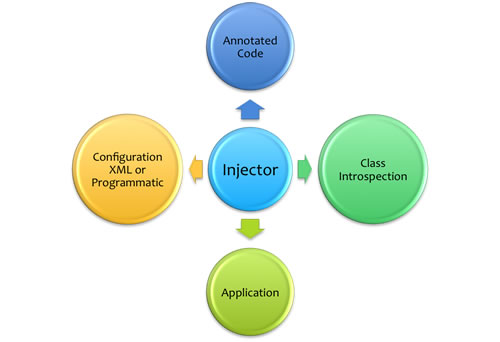
WireBox bases itself on the idea of creating object injectors (wirebox.system.ioc.Injector) that in turn will produce and wire all your objects. You can create as many injector instances as you like in your applications, each with configurable differences or be linked hierarchically by setting each other as parent injectors.
Each injector can be configured with a configuration binder or none at all. If you are a purely annotations based kind of developer and don't mind requesting pathed components by convention, then you can use the no-configuration approach and not even have a single configuration file, all using autowiring and discovery of conventions. However, if you would like to alter the behavior of the injector and also create object mappings, you will need a configuration binder. The next section explains the way to create this configuration binder, below is how to startup or bootstrap the injector in different manners:
No Configuration Binder:
myObject = new coldbox.system.ioc.Injector().getInstance("my.object");With a Configuration Binder:
myObject = new coldbox.system.ioc.Injector("myBinderPath").getInstance("CoolObject");The WireBox injector class is the pivotal class that orchestrates DI, instance events and so much more. We really encourage you to study its API Docs to learn more about its construction and usage methods.
Now that we have constructed our injector let's discuss a little about injection idioms or styles WireBox offers before we go all cowboy and start configuring and using this puppy. The styles shown below are written in execution order.
Motivation: Mandatory dependencies for object creation
Each constructor argument receives a inject annotation with its required injection DSL. Be careful when dealing with object circular dependencies as they will fail via constructor injection due to its chicken and the egg nature
Motivation: Great documentable approach to variable mixins to reduce getter/setter verbosity
Leverages the greatest aspect of ColdFusion, the dynamic language, to mixin variables at runtime by using the cfproperty annotations. Great for documentation and visualizing object dependencies and safe for circular dependencies.
Cons is that you can not use the dependencies in an object's constructor method-- instead use onDIComplete().
Motivation: Legacy classes
The inject annotation MUST exist on the setter method if the object is not mapped. Mapping must be done if you do not have access to the source or you do not want to touch the source.
Cons is that you can not use the dependencies in an object's constructor method-- instead use onDIComplete().
These are the three injection styles that WireBox supports and which style you choose depends on your requirements and also your personal taste. The setter method approach is linked to the way Spring and ColdSpring approach it which is the traditional JavaBean style of setXXX where XXX is the name of the mapping or object to pass into the setter method for injection.
The injector can be constructed with three optional arguments:
struct
false
structnew()
A structure of name value pairs usually used for configuration data that will be passed to the binder for usage in configuration.
coldbox
coldbox.system.web.Controller
false
null
A reference to the ColdBox application context you will be linking the Injector to.
If you are using WireBox within a ColdBox application, you don't even need to do any of this, we do it for you by using some configuration data in your ColdBox configuration file or conventions.
Argument
Type
Required
Default
Description
binder
instance or instatiation path
false
wirebox.system.ioc.config.DefaultBinder
The binder instance or instantiation path to be used to configure this WireBox injector with
properties
// Simple Creation - automatically stored in application.wirebox
new coldbox.system.ioc.Injector()

// Custom Binder
new coldbox.system.ioc.Injector( "config.MyBinder" )

// Custome Binder + Properties
new coldbox.system.ioc.Injector( "config.MyBinder", { props } )The following chart shows you the most common methods when dealing with the WireBox Injector. This doesn't mean there are no other methods on the Injector that are of value, so please check out the CFC Docs for more in-depth knowledge.
// A method you can use to send objects to get autowired by convention or mapping lookups
autowire(target,[mapping],[targetID],[annotationCheck])

// A utility method that clears all the singletons from the singleton persistence scope. Great to do in development.
clearSingletons()

// Checks if an instance can be created by this Injector or not
containsInstance(name)

// Get the configuration binder for this injector
getBinder()

// The main method that asks the injector for an object instance by name or by autowire DSL string.
getInstance([name],[initArguments],[dsl],[targetObject])

// Retrieve the ColdBox object populator that can populate objects from JSON, XML, structures and much more.
getObjectPopulator()

// Get a reference to the parent injector (if any)
getParent()

// Get a reference to a registered persistence scope
getScope(name)

// Set a parent injector into the target injector to create hierarchies
setParent(injector)